Wednesday, July 17, 2013

Connecting Science and History!

It is the middle of a hot week here in Virginia and I have been teaching a week-long workshop on Physical Science. So blessed to have 27 amazing elementary teachers playing, debriefing, and playing some more this week with me!  Take a look at some of the pictures and see if you can identify a common theme among them:


If you said the teachers look like they are having fun learning; you would be right!  But these pictures actually show two activities that connect to topics found in the Virginia Social Studies Standards of Learning.  

Making Water Flow Up!


Let's start with the fountain. Yes, we made a fountain in the classroom and did not make a mess! The history of the fountain can be traced back to Ancient Rome. Using a system of aqueducts, cisterns, and the force of gravity, Ancient Rome was able to received and store water. Gravity helped to move the water and cisterns, which are similar to what we know as water towers today, helped to store the water.  

Water flowed from the cisterns either through pipes to individual houses or to public distribution points. Fountains were not only decorative; but functional. People could bring their buckets to the fountain to collect water. Some of the fountains had elaborate sprays. These were due in part to the height of the cisterns.


Our fountain works off of air pressure. On top of the bottle is a balloon filled with air. Once released, the air rushes into the bottle and begins to force the water out through the straw. Even though the straw is pointed up, the pressure is great enough to make the water flow up and out of the straw! Keep reading for directions on how to make this easy, yet fun water fountain that will have your students or children shouting-"Can we do this again?"
Learning about Ancient Rome (grade 3) and the importance of aqueducts and fountains!
Sometimes Accidents in Science Create Fun 

In 1940, Franklin Roosevelt called rubber a "strategic and critical material." When our military success in the war became dependent on rubber production, the US government asked companies to invent a synthetic rubber that could be made with non-restricted materials. Scientist James Wright quickly began experimenting with various materials in his quest to discover synthetic rubber. 

The now famous goo, known as Silly Putty, was accidentally created through the combining of boric acid and silicone oil. Tests on the "new goo" done by Wright concluded it could bounce, stretch farther than regular rubber, did not mold, and had a high melting temperature. Unfortunately, it did not have the properties necessary to replace rubber. Originally called "nutty putty," the substance was a lot of fun to many people. After a series of events, it eventually made its way into the toy market and the rest is history!
Science is just plain fun at times!


Even though our Silly Putty is made from items you can find in Wal-Mart, we still had a great time exploring chemical changes! 

If you would like to have some fun this weekend, here is what you need:

Water Fountain

2 liter bottle
Straw
Blue Tac or Modeling Clay
Water

Directions:
Get ready for some fun!
  1. With a pen or a pair of scissors, poke a hole in the empty bottle just big enough for a straw to fit through.
  2. Seal the straw with Blue Tac or Modeling Clay.
  3. Pour water into the bottle over the level of the hole (we put the hole down lower on the bottle).
  4. Plug any leaks by squishing down the clay and make sure the straw is pointing up!
  5. Blow up the balloon, twist it slightly, and then put over the opening of the bottle. Let it untwist and get ready!
Silly Putty

To make silly putty, you need the following items:
  1. 1 4 oz bottle of glue
  2. 1/4 cup of  StaFlo starch
Pour these materials into a quart sized bag, seal, and mix together.

When the solid begins to form, open the bag and continue to knead inside the bag. Eventually you will be able to pull it out of the bag and have fun!

What other connections can you find between history and science? Just remember, science rocks!


M


Friday, June 14, 2013

Summer Science Fun


Ah, the air temperature has finally gotten over 75, the cicadas were out in full force last weekend up in Northern Virginia, and we just finished the last grading period. All parents and teachers know what that means!


Of course now comes the hard part! What do you do when you hear-"Mom, I'm bored!" Don't worry my friends, I have you covered! Science can always make the long summer afternoons a little more fun for all!

Marvelous Matter!

In two weeks I am doing training with a group of preschool teachers from Hampton. I am blessed to get the opportunity to do some really simple science with them. Super excited about this workshop as I will be teaching them about matter!

Solids, liquids, and gases oh my! Using water, teachers will learn the properties and other really cool stuff about matter. In preparing, I wanted to find an activity that would tie it all together and allow the teachers to learn how they could connect a topic again at another point in the year.

The best part about teaching matter is this- it's everywhere. Stop reading this blog now and look up. What do you see?  Do you see examples of solids? What about any liquids? Right now as you breathe in you are breathing a gas called oxygen and then you exhale a gas called carbon dioxide! I know you were just thinking how science is so cool!! 

So in my quest to find the perfect idea, I stumbled across this:

Of course those of you who know me really well know I see all things through a lens of science! And this was just the right way to end my workshop! What is better than taking a solid which has a specific property (allows light to pass through but not the images on the other side) and create something fun and pretty at the same time!

Using Matter to Make a Sun Catcher!
Here is what you need:
  • Different colored flat, glass, beads. ( I found these  and they were a really good price for bulk: http://www.wholesalersusainc.com; you can also get them from Michael's or any craft store) 
  • Clear Glue (you can use the regular glue, but it does not dry clear)
  • Picture frame (I got mine at the dollar store-who can beat a $1)
Steps:

Lay out the colors and work with your kids to make the design. You can provide your kids with a template or you can allow them to be creative.

First you put down a lot of the clear glue on the glass frame. I simply took out the guts of the back part of the frame so the glass was exposed.

Next, Hugh and I laid out our pattern on the table before we put them into the glue. Here you can see Hugh putting his together. Notice he has the beads in the rows as he wants to add them in the frame.


Hugh working on his creation!

This was what Hugh and I created together:


Beth decided to get more personal and tried her hand at making a letter B for her name!

Letter B for Beth!

Then all you do is put them in a place to allow them to dry really well. Here are two of the three final products(Beth's had not finished drying!):

So think of other ways you could use these translucent solid pieces of glass beads!! I already have dreams of doing the glass table I have outside on the back deck!


So how does this connect to Matter???

Matter is anything that has mass and takes up space. It can exist in 4 different states-solids, liquids, gases, and plasma. All matter has certain properties that helps it to be distinguished from other objects. The physical properties of an object can be observed with the five senses. These glass beads are a great example of matter and an example of how understanding the physical properties of an object can lead to innovation!

To start off a lesson on matter, give your children a couple of these glass beads. Ask them to use their senses (except their sense of taste) to generate a list of words to describe them. They may describe the colors they see, how hard they feel, maybe they might even say they feel cold.

You can have the children sort the beads into groups based on the physical properties. They can even compare and contrast using a graphic organizer! Then you can have them build the sun catcher!

So go get some glass beads and create a piece of matter art!


Friday, April 12, 2013

More book ideas!!


Here are some more books you have got to have!


Sea Squares by Joy N. Hulme illustrated by Carol Schwartz

Who doesn't love counting books! Throw in anything about nature and I am hooked! This book is a great counting book that uses nature,  but if you use it right, it can be used for some much more!

I love books with realistic illustrations and this one delivers! Two two-eyed gulls, with two wide wings, shrieking and swooping and pecking up things! 2 white gulls, with 2 eyes each, have 4 bright eyes to watch the beach! Hmmm, see a little addition as well!! 

Don't you just love the rhyme and rhythm of this book! Numbers are used by scientists to describe objects (to tell how much or how many of something). Yes, my friends, math is a language a scientist must be able to speak. Number words tell us a lot. As you read the passage above, even without the book, couldn't  you just see the picture forming in your mind?

There is also another neat feature of this book-see if you can see what I mean.


Make some observations of this picture. Do you see something cleaver in the lower right hand side of the picture? There are 4 little rocks. So while the children are focused on the four seals they see between the two pages, there are also 4 little rocks. Each page has hidden objects that also represent the number on the page! How cool. So you can ask your little reader-do you see 4 other objects on this page? Where and what are they?

Be sure to add this counting book to your library!


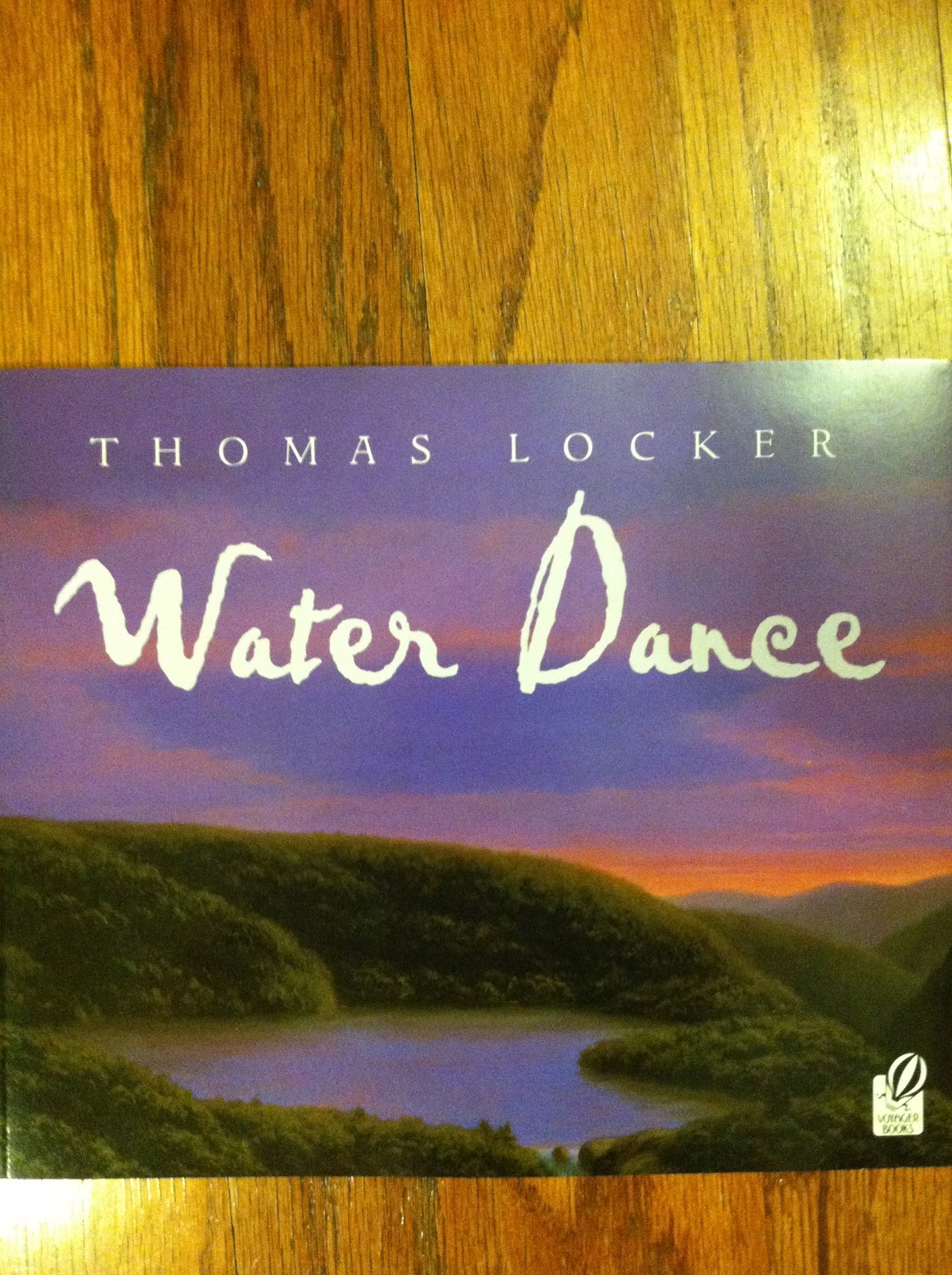
Water Dance by Thomas Locker


For all my friends who teach in the upper grades, this book is for you!  Thomas Locker has several books that I love; but this is one of my favorites! In Virginia, students have to understand the water cycle by third grade. Cycles are important processes in the natural world. Cycles often exist within systems. They are just events that repeat themselves while helping to maintain balance. The water cycle circulates water as it changes phase due to changes in temperature. I always tell teachers, the water cycle is not just about singing the cute little song (yes there is a song that goes with it). Children need to understand the water cycle is a natural example of matter changing phase. Water can exist in three states-solid, liquid, and gas. To change, it needs either heat or the absence of heat (cold). Heat from the sun evaporates water and changes it from a liquid to a gas. As the gas travels higher up in the atmosphere, the cooler temperatures help to change it back to its liquid state. Thomas Locker describes the next step in the water cycle so much better than I can, so check it out-

" Some people say that I am one thing. Others say I am many. Ever since the world began, I have been moving in an endless circle. Sometimes I fall from the sky. I am rain."

Beautiful! Add in his incredible paintings and you have the recipe for a classic!

"Sometimes I cascade. I tumble down, down, over the moss-covered rocks, through the forest shadows. I am the mountain stream."

So what phase/state of matter is water taking now in the water cycle? Yep, you guessed it! Liquid state! When you understand how content connects with the bigger ideas in science, it is easy for students to learn!

Get this book to make the water cycle come to life!

I hope you are inspired to use reading to spark a love of science (and math as well)! Now go read!

Tuesday, March 26, 2013

Fun Science Craft for Spring

Are you ready for spring!! 

In preparation for a workshop I did over the weekend, I came across an activity that discussed painting by freezing colored water. Those of you who know me really well, know that I am not one of those people to simply just believe something works. True to form, I tried it out.

Let me just say, this is one of the coolest things I have done in a long time! It just made me say-I Love Science!

This activity is a fun and inexpensive way to teach children about melting and freezing.  So go to the store today and get the supplies.
Here is what you need:
Bag of Straws

Ice tray
Food coloring-red, blue, yellow

This is what you do:
Add water to the tray and then the food coloring; stir


Straws-cut them and put in the water. These will be your handles-just put in before freezing


Then all you do is put in freezer and freeze!! When you take them out of the tray, they will look like this:
Cute!

 And soon you will be able to do this!
Painting a rainbow with colored ice!

This is a picture I painted. Don't you just want to say Science Rocks!!

Sunday, March 17, 2013

Great Science Books Inspire!

Books, books, books! My daughter walks around with a book hooked to her nose almost ever day! I love that she loves to read so much. Frederick Douglass once said,“Once you learn to read, you will be forever free.”  Books open up a whole different world to children. In books, children can go to far off places. They can become a scientist who cures a life threatening illness. In the classroom, books can also be used to help build vocabulary and inspire students. Over the next few weeks, I am going to share some of my favorite books. Of course you know these books are going to be all about science topics, but I threw in some math books as well!


An Egg is Quiet by Dianna Aston and Sylvia Long


Several posts ago, I wrote about one of my favorite science activities to spark curiosity. In the activity, you take an egg and put it in vinegar to see what happens (check out my previous post for directions). This is the book I use after doing the activity. 

What makes this book fantastic is not just the incredible illustrations, but the language. Dianna Aston uses vivid language to describe the physical properties of eggs found in nature. For example, eggs in the wild can be round (Ridley Sea Turtle), oval (Ladybird Beetle Egg), pointy (Common Murre), and tubular (Dogfish). Tubular dude! No, this is not just a shout out to all my friends born in the 80's!  Tubular is the word that best describes the Dogfish's egg sack!

The book also describes how eggs are textured-they can be hard, soft, gooey, smooth, and rough! I just love how describing words are used to articulate how these eggs would feel if we could tough them! 

Observations are very important to the work of a scientist. Scientist use words to describe what they see, feel, hear, and smell. I don't like to use taste often because scientists do not taste things in their labs. But for another group of people, taste is really important-chefs! Think about how chefs use words to describe how food tastes! 

Observations really lead to an understanding of what makes up an object and the relationship between what the object can do. Think structure (what it is made up of) and function (how it works). The relationship between the two can help scientists get a better sense of how the object can be used in the real world. Let's go back to the Dogfish egg sack. Take a look at  it's tubular (just love saying that word! And so do little ones!) shape-see picture below. What do you observe off the ends of the tubular sack? See the little strings? What do you think they are used to do?


If you said they act like an anchor (did you cheat and read the page?), then your idea would be right. They anchor the egg sack to seaweed so it does not get swept away with the current. Their function is to help protect the sack. In essence, the strings help the eggs to survive! 

What the sack is made out of also helps the eggs to survive. Its leathery texture makes is harder for prey to break it open. It also prevents water from getting in and drowning the eggs. Again, the structure leads to the survival of the Dogfish when it is in the most delicate stage of it's life cycle.

Once children get the hang of understanding the relationship between structure and function, they can use that knowledge to inspire innovation. Did you know velcro was invented from those pesky burrs that love to hook a ride on your pants leg? 

So if you want a great book to build words while inspiring lots of questions, this is the book for you! Children will also learn lots of information about animals. Stay tuned for more books!


Saturday, February 23, 2013

Science and Technology


Last week I was lucky enough to get a new I-Phone and the best part-it was free! Gotta love the fact your phone is so old,  you qualify for a free upgrade! 

Like a kid on Christmas morning, I had more fun finding apps! As I scanned the apps I downloaded, I realized almost ever single one of them had something to do with making my life more efficient or effortless.

This of course got me thinking. Can technology really make our lives easy or does it just complicate it more?

From the first microscope to the newest telescope, technology has changed the way we learn about the world, how we problem solve, and how we relate to each other. Scientist have certainly been able to unravel the mysteries of how this world works. Although they may never have all the answers, technology is allowing them to get close.

I still remember the day in July of 1999 when our school system began running Group Wise! Suddenly we went from having conversations on the phone to only speaking to people through electronic means. That was also the year I learned how to develop a web page and systematically managed to put the VBCPS Middle School Science website up as the VBCPS website! To this day I can’t tell you what I did, but I remember when I had to call IT and let them know “VBCPS, we have a problem!” Oh well, for five fleeting minutes, my work was famous!

As I have gotten older, I find myself picking up the phone more; wanting to simply hear a voice as opposed to reading words on a screen. I often wonder what my children’s life will be like in 10 years given the rate of change with technology.

I have found in the last five years that there are some technological tools that have made my life a little easier. Here are some cool apps I found that you might like as well-although I am sure many of my friends already know about them! I tend to be behind in the technology age! 


This app was downloaded after I asked my husband the question-can we find a grocery app that would allow us to have one list that updated automatically regardless of who put in the information. 

What a cool little app! After downloading it, I accepted a link from my husband and bzinga! We now have the Flannagan Grocery List! Yep, when either Bill or myself go to the grocery store, we can see what needs to be purchased. Just this morning I got up and there was the new Flannagan list for the upcoming vacation week!

So what else can this little app do? It has a built in coupon section. For the categories in the grocery list, you will find coupons linked to it. The only caveat to this is the coupon may not always be for what you need to buy but rather is for something also found in the category-like produce. Once you clip a coupon, you can print directly to your printer if it is wi-fi enabled or you can email them to yourself to print. 

There is also a location feature that allows you to find all the stores in your area. 


This little app is free and is a fun, navigation tool! Billed as a community navigation tool, this app allows you to post traffic updates, where cops are hiding, and can even allow you to share a drive. I also love the fact you can search for the cheapest gas! If you want to, you can even put in your mood for the day while you drive. The other day I was a ninja-yep slicing and dicing my way through traffic to get home!

In the groups setting, you can share the most relevant and up-to-date information about your commute. Of course the information is from people who actually drive the route every day! The only problem I have had with this app was on a recent trip to DC. For some reason, my route kept changing all by itself. Maybe the software had become possessed, or maybe someone was trying to get me to go a different direction. Either way, I had to keep rerouting myself. But as my husband reminded me, no technology device is perfect!

While technology may not be perfect, there are some technology tools that  make life a little easier. If a simple little grocery app can make our trips to the grocery store more productive, it was worth the download!

Saturday, February 16, 2013

Red Sky in the Morning!

Red sky in the morning! Watch out!
When my children were little, they used to notice the red sky and inquired why it was red. In my explanation, I shared the statement my mom had shared with me-

Red Sky at night, sailor's delight.  Red sky in the morning, sailor take warning


Of course when they were little, it was a little easier to get them to believe me. I will never forget the day my daughter, in her wisdom, said to me "Really mom?How can simply looking at a red sky predict bad weather moving in!"

This morning, my son shouted this phrase as we looked outside and he quickly saw the pink hue on the morning clouds. With the prediction of snow for today, he is eager to see if the warning will come true!

Weatherlore or Weather Folklore is related to the prediction of weather. For centuries, people have been fascinated with the weather and with trying to forecast upcoming weather. As people made observations of the sky, water, and even insects, those observations were soon connected to changes in the rhythms or patterns of weather.
These observations were then translated into short sayings or rhymes for ease of memory. These sayings were then passed down from generation to generation. Some have been altered by the wisdom of the times.
Here are some ways weatherlore was used in the past:
·     Farmers used to watch cloud movement and the sky color to know when to sow and reap.
·     Mariners noted wind shifts and observed wave motions for signs of change.
Believe it or not, there is some truth to some weather folklore statements! Here are a couple that have been proven to be true:

  • Halo around the sun or moon, rain or snow soon
  • Clear moon, frost soon

Click here for a kids weather site that has some other statements. Here is another great site with lots of great information.

Start collecting data to see if any other of the weatherlore statements are true!

Go Science!